There is a detail in this story that most people don’t know, and it changes everything.
During the COVID-19 pandemic, when churches across Birmingham were scrambling to find ways to keep their congregations together, Redeemer Community Church found an unlikely sanctuary: the parking deck of the then-vacant Trinity Medical Center campus on Montclair Road. Week after week, hundreds of members gathered on that open-air concrete structure to sing, pray, and worship together, finding community in a building that had once served as one of Birmingham’s most prominent hospitals.
That parking deck belonged to Broad Metro.
Years later, in February 2026, Redeemer Community Church closed on the purchase of the entire Trinity campus: more than 25 acres, 1,200 parking spaces, and the buildings that will become its permanent home for generations of Birmingham families. The seller, again, was Broad Metro.
For Will Kadish, it was never just about real estate. It never has been.
What His Father Taught Him
Will Kadish did not arrive at his philosophy of real estate development on his own. His father, Lawrence Kadish, shaped it.
Lawrence has built a career on a principle that Will heard so many times growing up it became instinct: the best real estate is not the most profitable transaction. It is the one that leaves a place better than you found it. Lawrence believes that developers carry a responsibility to the communities they enter, and that the long view, taking on hard properties, staying patient through uncertainty, investing when others won’t, tends to produce both better outcomes for communities and, eventually, better outcomes for the developer. Not always. But often enough to live by.
Will took that framework to Alabama. When Broad Metro began work in Birmingham, the team was drawn to opportunities that tested the principle: properties that were complicated, underutilized, and overlooked. Places where patient, community-minded development could make a genuine difference.
The former Trinity Medical Center campus was one of the most demanding tests of that philosophy they had encountered.
“My father taught me that you don’t just buy a property, you take on a responsibility. He used to say that how you leave a place matters more than how you found it. I think about that a lot, especially on a site like Trinity, which meant so much to so many people for so long. You feel the weight of that. You want to honor it.”
Will Kadish, Principal, Broad Metro
A Decade of Quiet Work
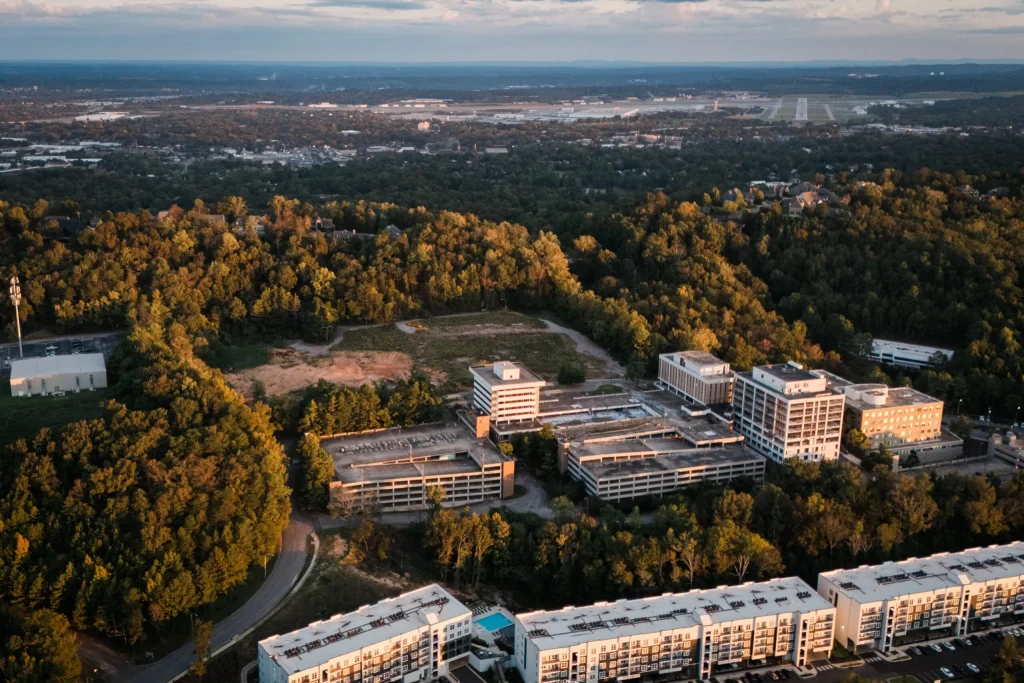
Broad Metro and the Kadish family acquired the former Trinity Medical Center site after the hospital vacated in 2015, consolidating its operations at the newly built Grandview Medical Center on Highway 280. The campus, originally built in 1966 as Baptist Medical Center Montclair, had served eastern Birmingham for nearly five decades. It sat on 75 acres embedded in Red Mountain, overlooking Crestline Village and Mountain Brook. By any measure, it was one of the most significant dormant properties in the city.
It was also genuinely difficult. Large, aging hospital campuses do not redevelop quickly or cheaply. Plans that look promising on paper run into regulatory complexity, infrastructure demands, and market timing. Broad Metro announced an ambitious mixed-use vision for the site in 2020, and the pandemic changed the calculus, as it did for development projects across the country.
Through all of it, the team kept working. The former hospital building itself had sustained serious flood damage over the years and was structurally and environmentally compromised. Bringing it down was the necessary first step. Broad Metro turned to Britt Demolition, a company that brought both the expertise and the pricing to make the project feasible, and the work got done. With that land cleared, Broad Metro worked with Ingram Tynes of Tynes Development to build what became The Station at Crestline Heights on the parcel closest to Montclair Road: 277 units of high-end residential housing that activated the street edge of the property. Tynes later acquired one of the three remaining office buildings on the campus. The other two, the 860 Montclair building at 145,000 square feet and the 840 Montclair building at 105,000 square feet, both connected to the 1,200-space parking deck, would ultimately find their way to Redeemer.
None of that work generated headlines. It was the kind of unglamorous, incremental stewardship that rarely gets noticed until, one day, it makes something else possible.
In this case, what it made possible was Redeemer.
A Church That Outgrew Every Room It Ever Had
Redeemer Community Church was founded in 2008 by Joel Brooks in his living room. The congregation moved through a series of borrowed and rented spaces across Birmingham before settling into its Avondale sanctuary at 4002 Fourth Avenue South in 2014, a historic building that had previously served South Avondale Baptist and New Hope Baptist.
When Redeemer moved in, the 600-seat sanctuary held fewer than 200 people. It was a good problem to have. By 2025, the congregation had grown to nearly 2,000 members. The building, the classrooms, the gathering spaces: none of it could hold what Redeemer had become. It was not just a space problem. It was a mission problem. A church that defines itself by hospitality and community presence cannot keep turning people away at the door.
During the pandemic, when indoor gatherings were restricted, Redeemer began holding worship services outdoors on the parking deck of the Trinity campus, just 1.5 miles from their Avondale home. Hundreds of members gathered on that concrete structure week after week. They worshiped in the open air, surrounded by a dormant building, and kept the congregation together through one of the most disorienting periods any of them had lived through.
Whether anyone recognized it at the time or not, Redeemer and the Trinity campus had already begun to find each other.
The church publicly announced its intention to acquire the Trinity campus in April 2025, describing it as a “unique opportunity,” a rare alignment of location, size, infrastructure, and value. What began as a contract for two buildings and a parking deck expanded into the acquisition of the entire remaining campus. The final closing came in February 2026, with a total purchase price of $11 million, the final chapter in a decade of transactions that unlocked the full value of the campus.
The church’s vision for the site, which it has named “For Generations to Come,” is a permanent foundation for ministry, hospitality, and gospel presence in Birmingham, not just for the members in the pews today but for the generations of believers who will follow.
“I want to be honest: our team did the work, but the way this came together was not something we engineered. A church worships on your parking deck during a pandemic, and years later they end up being the ones to carry the property forward. You don’t plan that. You just try to stay faithful to the city you’re working in, surround yourself with good people, and trust that if you do the right thing with what you’ve been given, it tends to work out the way it’s supposed to. I’m grateful. That’s really all I can say.”
Will Kadish, Principal, Broad Metro
What Comes Next
Redeemer has not yet released detailed development plans for the campus. What the church has made clear is that the property will serve as a long-term base for growth, ministry, and what it calls “deep hospitality,” rooted in the conviction that a church is defined by its relationship to the city around it, not just the people within its walls.
For Birmingham, the acquisition ends a decade of uncertainty around one of the most visible dormant properties on the east side of the city. A site that provided healing for generations is going to keep doing that. Just differently.
For Broad Metro, this outcome is a reflection of the values the company was built on. Not every project resolves this cleanly. But when patient stewardship, honest dealing, and genuine commitment to a community line up the right way, sometimes the result is something that no one could have drawn up on a whiteboard.
“I don’t take credit for this. Our team worked hard and I’m proud of every one of them, but credit for the outcome belongs somewhere else. A place that served this community as a hospital for decades is now going to serve it as a church home. That continuity of purpose, a building that keeps healing people, just in a different way, that’s not real estate strategy. That’s something bigger than us. We just tried not to get in the way of it.”
Will Kadish, Principal, Broad Metro
Some transactions close and the story ends. This one feels like it is just beginning.
Coverage
Bham Now: Redeemer Community Church acquires $15.2M Trinity Medical Center site
Birmingham Watch: Avondale Church Buys Last of Trinity Hospital Campus